The Science of Gluten-Free Baking (Cheat Sheets)
If you have ever baked a gluten-free cake that turned out gummy, gritty, or hard as a rock, I have good news: It probably wasn't your fault.
Gluten-free baking is less about "cooking" and more about chemistry. When you remove wheat flour, you remove the structure, the elasticity, and the hydration balance. To fix it, you can't just swap one flour for another—you have to rebuild the entire equation.
Over the years in the @sweetlymeasured kitchen, I’ve tested hundreds of combinations to find the exact ratios that replicate that "bakery-style" texture without the gluten (and often without the grains).
I’m sharing my entire playbook below. These are the exact flours, fats, sweeteners, and ratios I use every day. Bookmark this page—it’s going to be your new baking bible.
Part 1: The Flour Guide 🌾

Gluten-free baking feels gritty because most people use the wrong flour for the job.
Here’s what I actually bake with and why.
If you want gluten-free desserts that taste bakery-style and aren’t overly sweet or gritty!
Gluten-free baking often feels gritty because most people use the wrong flour for the job. Here is exactly what I bake with and why.
(Insert your Flour Graphic here)
My Pantry Staples:
• Almond Flour: Provides moisture and tenderness. Best for cakes, cookies, and brownies.
• Oat Flour: Adds softness and structure. Great for muffins and quick breads.
• Coconut Flour: Soaks up moisture and firms batters. Note: Use sparingly, it is very absorbent!
• Cassava Flour: Provides structure and chew. This has the closest texture to wheat flour.
• Tigernut Flour: A fiber-rich, nut-free alternative to almond flour that adds mild sweetness.
• Tapioca Starch: Adds chew and elasticity. This helps with stretch and binding.
Whythis works:
Part 2: my Master Gluten-Free Flour Ratios

The biggest mistake people make is swapping flours 1:1 without adjusting for texture. You can't just replace wheat flour with almond flour—it will be too wet. You can't just use coconut flour—it will be too dry.
The secret is balancing the weight (heavy flours) with the lift (starches).
Here are the exact formulas I use in the @sweetlymeasured kitchen to get that perfect "bakery-style" crumb.
(Insert your Ratios Graphic here)
The Everyday Grain-Free Blend
• The Ratio: 2 parts Almond Flour : 1 part Tapioca Starch : 1 part Coconut Flour
• Why it works: This is my go-to "workhorse" blend. The almond provides moisture, the tapioca adds chew/binding, and the coconut flour structures it so it doesn't fall apart.
The Almond & Oat Blend
• The Ratio: 1 part Almond Flour : 1 part Oat Flour
• Why it works: A simple 50/50 split. The oats bring a fluffy, substantial crumb that balances the density of the almonds.
The Nut-Free Blend (Cassava Base)
• The Ratio: 2 parts Cassava Flour : 1 part Tapioca Starch : 1 part Coconut Flour
• Why it works: Perfect for school-safe baking. Cassava is the closest single-ingredient texture to wheat, but the tapioca lightens it up.
The Almond & Cassava Blend
• The Ratio: 1 part Almond Flour : 1 part Cassava Flour
• Why it works: This combines the protein/structure of cassava with the fatty moisture of almond flour for a rich, tender bite.
The Nut-Free "Everyday" Blend (Tigernut Base)
• The Ratio: 2 parts Tigernut Flour : 1 part Tapioca Starch : 1 part Coconut Flour
• Why it works: Tigernut flour is naturally sweet and rich in fiber, making it a fantastic nut-free alternative to almond flour in my standard ratio.
The Oat & Coconut Blend
• The Ratio: 2 parts Oat Flour : 1 part Coconut Flour
• Why it works: Coconut flour is very thirsty, so it creates a sturdy structure that prevents the oat flour from becoming too gummy.
⚠️ Important Note:
These ratios are shown by VOLUME (cups/spoons), not weight. Because different flours have different densities, measuring by volume is how I developed these specific balances.
Part 3: My fat equation explained

We talk a lot about flour blends in gluten-free baking, but FAT is actually what determines the final texture. It decides if your bake is fluffy, fudgy, crispy, or soft.
If you’ve ever wondered why I use oil in one cake but butter in another (or why I use specific types of oil), here is the breakdown.
The science behind the fats I keep in the @sweetlymeasured kitchen:
🥥 Refined Coconut Oil
- The Science: Structure + Binding + Neutral Flavor. Because it’s solid at room temperature, it acts like butter to hold cookies together. Crucially, the “Refined” version has zero coconut taste, making it the perfect undetectable swap.
- Best For: Cookies & Pancakes.
🥑 Refined Avocado Oil
- The Science: Neutral Flavor + Loft. This is the secret to high, fluffy cakes. It is light enough to let the batter rise (“loft”) without weighing it down. Note: Make sure to get “Refined” (pale yellow)—the green “Virgin” kind tastes like avocados!
- Best For: Cakes & Delicate Sweets.
🫒 Extra Virgin Olive Oil
- The Science: Moisture + Density. The opposite of avocado oil! It creates a rich, dense crumb that stays moist for days.
- Best For: Brownies & Fudgy Textures (or to add a fruity note).
🥛 Canned Coconut Milk
- The Science: Richness + Dairy-Free Creaminess. Crucial Distinction: This is NOT the carton milk from the dairy aisle! You need the high fat content from the can to replace heavy cream.
- Best For: Moist Cakes & Ganache.
🧈 Butter (or Vegan Butter)
- The Science: Flavor + Richness. Nothing mimics the mouthfeel of butter. If you use dairy, the milk solids help with browning; if you use vegan butter, it adds that essential richness.
- Best For: Muffins & Flavor-forward bakes.
⚪️ Palm Oil Shortening
- The Science: Stability + Structure. It has a high melting point, meaning it resists spreading in the oven (great for crisp edges) and holds its shape in frosting.
- Best For: Frosting & Pie Crusts.
Part 4: The Sweetener Strategy 🍯
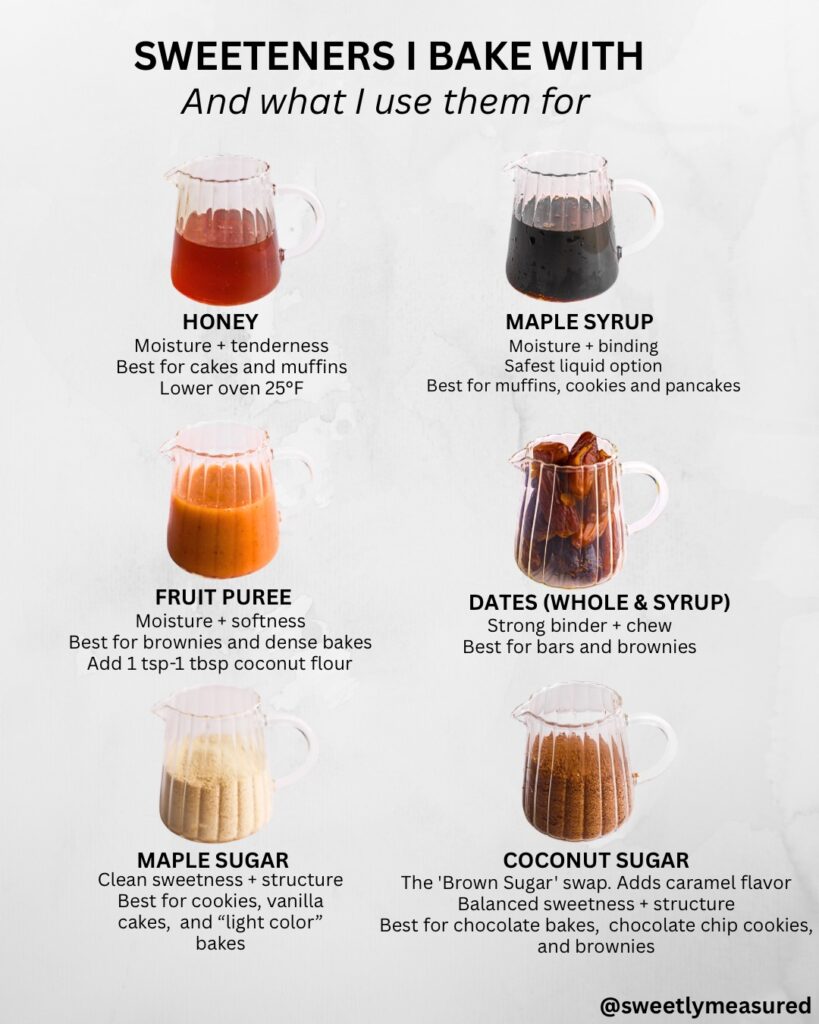

In grain-free baking, sugar does more than just sweeten—it provides moisture and texture. If you swap a liquid sweetener (like maple syrup) for a granulated one (like coconut sugar), you throw off the entire wet/dry balance.
Here is how I choose which sweetener to use for specific textures:
(Insert your Sweeteners Graphic here)
The Liquid Sweeteners (Moisture & Binding)
• Honey:
• The Science: Adds significant moisture and tenderness.
• Best For: Cakes and muffins.
• ⚠️ Important: Honey browns quickly! Lower your oven temperature by 25°F to prevent burning.
• Maple Syrup:
• The Science: Provides moisture and binding power. This is my "safest" liquid option for general baking.
• Best For: Muffins, cookies, and pancakes.
• Fruit Puree:
• The Science: Adds moisture and extreme softness (great for fudgy textures).
• Best For: Brownies and dense bakes.
• ⚠️ Important: It adds extra water content, so add 1 tsp - 1 tbsp of coconut flour to balance it out.
• Dates (Whole & Syrup):
• The Science: A strong binder that adds "chew."
• Best For: Bars and brownies.
The Granulated Sweeteners (Structure & Crispness)
• Maple Sugar:
• The Science: Provides clean sweetness and structure without dark color.
• Best For: Cookies, vanilla cakes, and "light color" bakes where you don't want a caramel taste.
• Coconut Sugar:
• The Science: The perfect "Brown Sugar" swap. It adds a caramel flavor, balanced sweetness, and essential structure.
• Best For: Chocolate bakes, chocolate chip cookies, and brownies.Sweeteners don’t just add sweetness.
They control moisture, structure, and browning.
If you’ve ever had an almond-flour cake burn on the outside but stay raw in the middle, that’s often the sweetener, not the oven.
This guide shows how different sweeteners behave in gluten-free baking so you can choose based on function, not habit.
Granulated sugars support structure.
Liquid sweeteners increase moisture and chew.
Purées soften without adding lift.
I’m breaking gluten-free baking down step by step : flours, sweeteners, ratios, eggs, and fats
…. so adjustments stop feeling random.
The Final Word
Baking without gluten doesn't mean lowering your standards. Once you understand how these ingredients interact—how Refined Avocado Oil creates loft, or how Cassava Flour mimics wheat—you can bake anything.
Want to see these ingredients in action?
Check out my [Recipe Index] to see how I combine these exact ratios to make everything from waffle donuts to birthday cakes.
Which chart was the biggest "lightbulb moment" for you? Let me know in the comments!
part 5: speciality flours

Baking without grain isn't just about "swapping" ingredients; it’s about understanding the unique framework each flour provides. To get that perfect, balanced texture, I rely on these six powerhouses to do the heavy lifting in the kitchen.
• Arrowroot Flour: Best for lightness and a crisp texture. I reach for this for cookies, browning, and fruit fillings.
• Sorghum Flour: This is my go-to for softness and structure. It’s great for muffins, cakes, and those moist quick breads.
• Buckwheat Flour: Perfect for elasticity and a deep, earthy flavor. It shines in galettes, tarts, and dark chocolate bakes.
• Garbanzo Bean Flour: Provides high protein and "elite" structure. Best saved for savory bakes and hearty bread recipes.
• Sweet Rice Flour: The ultimate binder for pastries and mochi. Use this when you need chew and elasticity.
• Quinoa Flour: Essential for building a dense, hearty framework. Best for your heaviest, most "measured" bakes.
Part 6: The Gluten-Free Egg Equation
Structure is the biggest challenge in a grain-free kitchen, and eggs are the key. I’ve standardized these ratios across my most popular recipes to ensure you get a consistent, successful bake every time you preheat the oven.

Ali’s Pro-Tip
Always use the highest quality eggs you can find. Since our "Sweetly Measured" style relies on fewer, cleaner ingredients, the quality of each one—especially your binder—makes a massive difference in the final flavor and texture.
Would you like me to draft a "Specialty Flour Substitution" chart for when your readers are missing one of these six flours?